
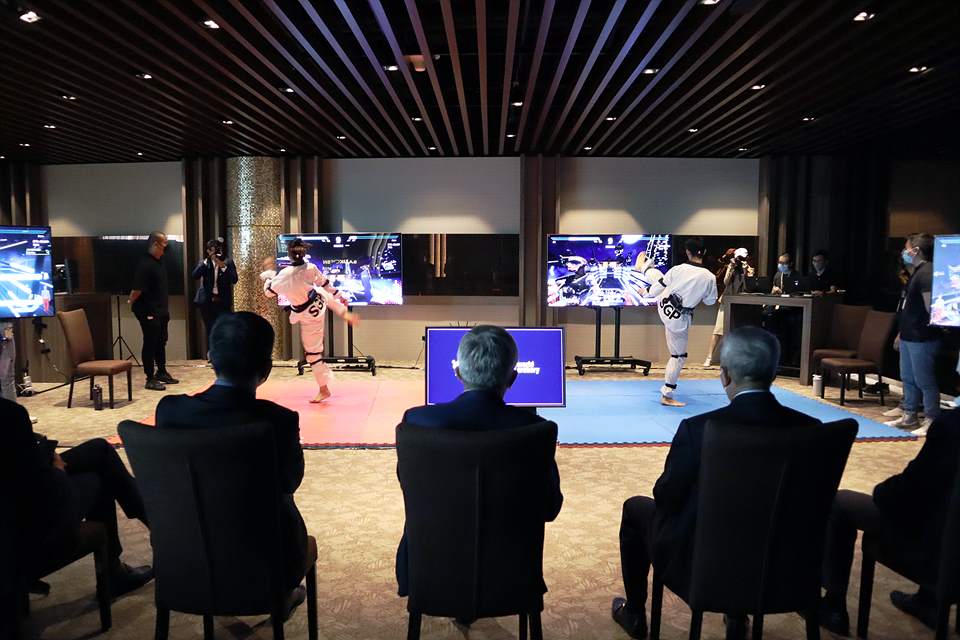
Virtual taekwondo, one of six sports making their Asian Games debut, uses VR headsets and motion sensors to pit athletes against each other as digital avatars. (Photo: World Taekwondo)
Malaysia’s Asian Games gold in Gran Turismo 7, won by Taj Izrin Aiman Taj Madira, shows how much the Games have changed. Six sports are making their debut in Aichi-Nagoya this year, and two newcomers from the last Games are back. Here’s what’s new.
The debutants
1. Mixed Martial Arts (MMA)
MMA mixes striking, throws and ground fighting, and bouts end by knockout, submission or judges’ decision. The sport grown in popularity in recent years so it is not that surprising that it has made it to Asian games. There are six weight classes, four for men and two for women.
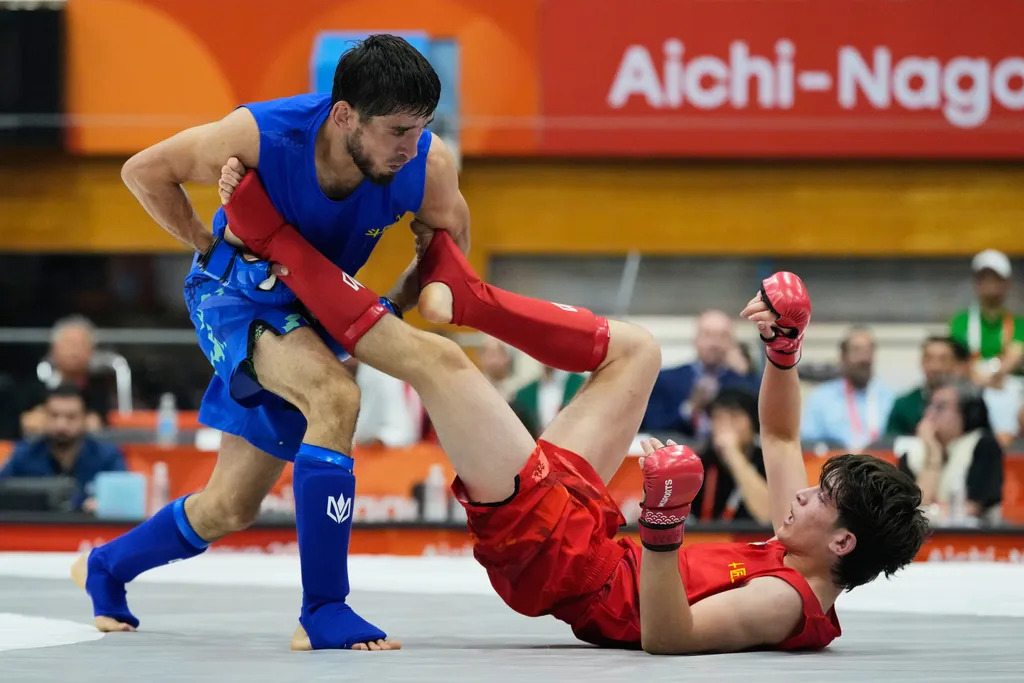
Uzbekistan’s Firdavs Atamuratov battles Tajikistan‘s Mirzobek Umarov in the men’s 60kg modern mixed martial arts final at the Asian Games in Nagoya, Japan, on Sept 22, 2026. (Photo: AP)
2. Teqball
Football on a curved ping-pong table, with no hands or arms allowed. Teqball was only invented in Hungary in 2012 and already has five Asian Games medal events. Neighbours Thailand, Vietnam, Cambodia, Laos, Myanmar and the Philippines all competed.
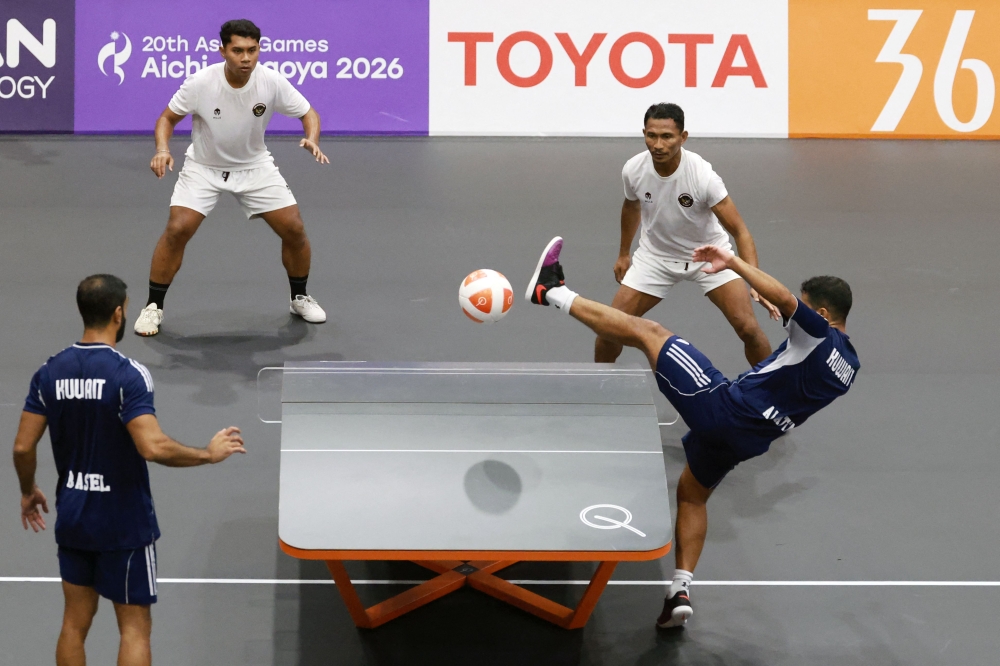
Kuwait and Indonesia square off in the Asian Games men’s doubles teqball bronze medal match in Nagoya on Sept 20, 2026. (Photo: AFP)
3. Padel
If you’ve seen new glass-walled courts popping up around the Klang Valley, that’s padel. It’s played in doubles on a court a third the size of a tennis court, and the ball can be played off the walls, as in squash. It’s the racket sport growing fast in the world and it gets its first Asian Games medals from 28 September to 3 October.
4. Surfing
Forty-eight surfers from 17 nations ride the waves at Akabane Long Beach in Tahara from 25 to 29 September. Regional surfing nations Indonesia and the Philippines will be ones to watch.
5. Freestyle BMX
Riders do spins, flips and tailwhips off ramps, and judges score difficulty, execution and height. BMX racing has been at the Asian Games before, but this is the first time for the freestyle discipline.
6. Virtual Taekwondo
This is really the most unusual addition as it has made Taekwondo a non-contact sport, sports purist will not be happy with this development but this is still a physical sport in a way as the the humans act as the controller rather holding one. Athletes wear VR headsets and full-body motion sensors and fight opponents as digital avatars. There’s no contact, only real kicks against a virtual opponent, on 2–3 October in Toyohashi.
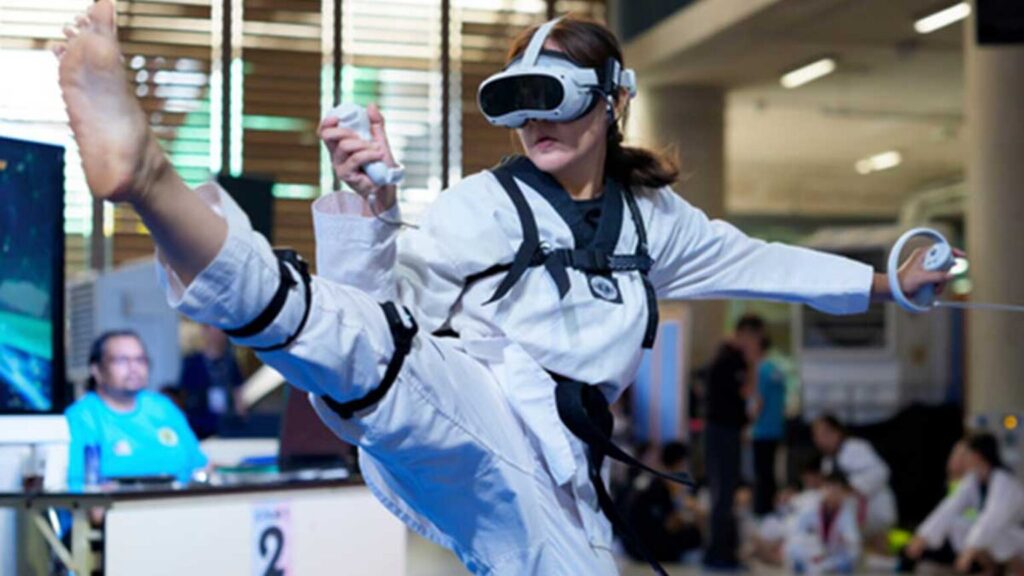
A virtual taekwondo athlete launches a high kick during a tournament in Kuala Lumpur, Malaysia, on June 20, 2026. (Photo: AP)
Second time around
Esports
Esports has grown steadily. It was a demonstration sport at Jakarta-Palembang 2018, became a medal sport with seven events at Hangzhou 2022, and now has 11 medal events. Malaysia has entered 9 of the 11 and is aiming for at least five medals. With one gold already won, Malaysian fans have plenty more to watch, especially Mobile Legends: Bang Bang, PUBG Mobile and eFootball.
Breaking
Paris 2024 gave breaking its Olympic debut and a viral meme: Australia’s Rachael “Raygun” Gunn scored zero points and her kangaroo hop was mocked around the world. Breaking isn’t going to be LA 2028 Olympics but The Asian Games are keeping it at least for this edition . The categories included are B-Boy and B-Girl and it happens on 2 and 3 October.
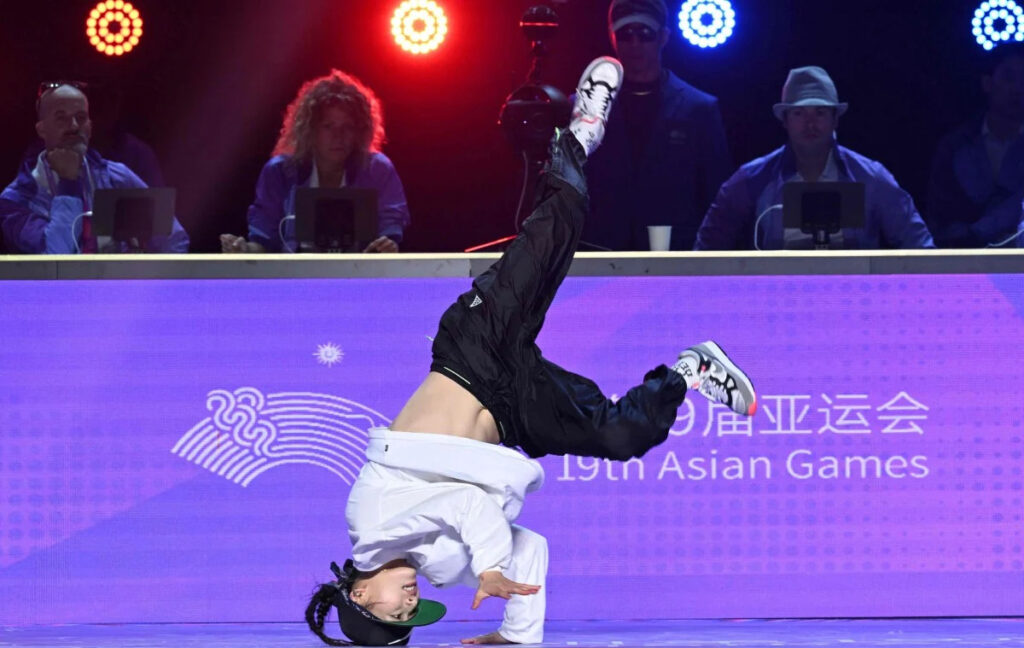
South Korean B-Girl Jeon Ji Ye, known competitively as Freshbella, showcases her breaking moves at the 2023 Asian Games in Hangzhou. (Photo: AFP)
The Asian Games are embracing newer sports. Not every one will become a regular fixture, but esports has gone from exhibition to 11 medal events in eight years. For Malaysia, it’s also become a sport that could contribute golds to our tally.